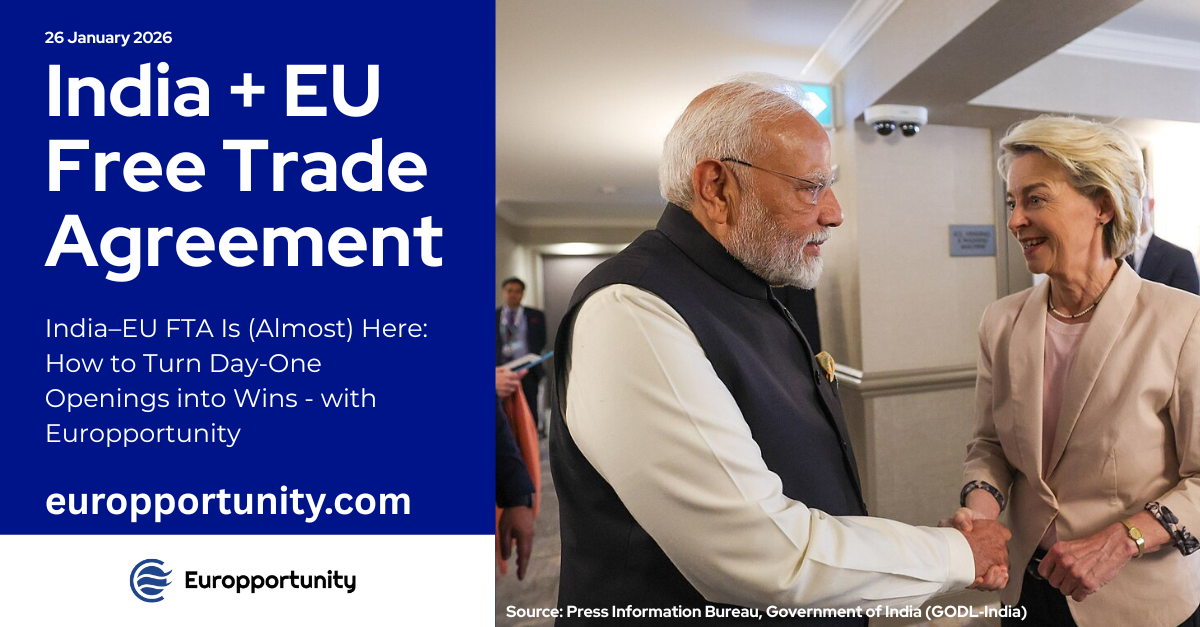
After nearly two decades of negotiations, India and the European Union are poised to conclude a landmark Free Trade Agreement. The announcement of the deal’s conclusion is expected at the EU–India Summit in New Delhi, with formal signature and ratification steps to follow. Translation: market access is about to get simpler—but preparation will decide who captures the upside first.
What’s likely in the FTA—and what’s not
- A comprehensive pact focused on goods, services, and trade rules, with sensitive agriculture expected to remain largely outside the scope.
- Tariff cuts on many products—some immediate, others phased—plus provisions that ease services trade.
- A ratification runway in Europe, so implementation will roll out in stages. Being “FTA‑ready” now will separate leaders from laggards.
Where the near‑term opportunities lie
- Tariff relief for Indian exporters. Labor‑intensive sectors (textiles, garments, leather), electronics, gems & jewellery, pharmaceuticals, and engineering goods stand to regain competitiveness—subject to product coverage and rules of origin.
- Services expansion. Indian IT, telecom, business, and professional services could benefit from clearer mobility pathways and regulatory alignment as the deal moves into force.
- Balanced supply chains. European exporters will gain improved access to India in autos, machinery, chemicals, and high‑value services—creating complementary B2B demand across both markets.
Mind the hurdles
Even with lower tariffs, non‑tariff barriers (standards, testing, certifications) and the EU’s carbon border levy could shape realized gains. Budget for compliance readiness and lead times.
How Europportunity turns FTA potential into pipeline and revenue
When markets open, speed and local credibility win. From our base in Frankfurt, Europportunity helps Indian and other non‑EU companies establish a legal presence in Europe, build pipeline, and operate compliantly from day one.
1) Company setup in Germany (GmbH)
Germany is Europe’s economic engine and a trusted base for EU‑wide operations. We guide you through end‑to‑end GmbH formation—Articles of Association and notary support, bank account opening, Commercial Register filing, tax/VAT registration, trade license, and payroll/social security onboarding. We advise on the right entity (GmbH, UG, AG, SE, partnerships) based on your capital, risk, and governance needs.
Need a local Managing Director (Geschäftsführer)? Our “Geschäftsführer as a Service” provides an experienced, contract‑bound representative for regulatory filings, bank and authority interactions, statutory submissions, and governance reporting—while you retain control over day‑to‑day business. An EU legal entity with local signatory power makes rules‑of‑origin compliance, VAT, contracting, and customer onboarding far smoother—often a prerequisite for tenders and key accounts post‑FTA.
2) Sales & marketing that creates demand—not just visibility
Market entry succeeds on traction, not just a trade registry excerpt. Our senior European business developers work as an extension of your sales organization to accelerate coverage and credibility:
- Segment prioritization and named‑account plans for high‑potential industries.
- Trade‑fair strategy and on‑site brand representation.
- Lead generation and deal support—first meetings, tailored decks, proposals, pricing, channel selection, and negotiations.
- Thought leadership and content (white papers, panels, bylines) to position your brand where buyers are.
3) Business guidance & ongoing compliance—so nothing slips through the cracks
Operating in the EU means getting finance, tax, HR, and legal right from day one:
- Tax/finance setup with a fit‑for‑purpose Steuerberater; bookkeeping (e.g., DATEV), VAT education, and return schedules.
- Communications with authorities—Finanzamt, Gewerbeamt, and other bodies.
- Licenses and certifications—EORI, trade permits, and sector certifications.
- Contracts and HR—lawyer coordination for customer/vendor/employment agreements; payroll providers; statutory insurance and social security onboarding.
- Continuous advisory—deadline tracking and regulatory updates (including e‑invoicing and sustainability requirements).
Have questions about setting up German GmbH?
A practical FTA‑readiness checklist
1) Map your HS codes to expected EU tariff outcomes and rules of origin; model price/volume scenarios by SKU and customer.
2) Prioritize segments and named accounts for early wins—and line up meetings at upcoming European trade fairs.
3) Decide on your EU foothold (GmbH vs. alternatives) and assign local signatory power to accelerate banking, tax, and contracting.
4) Pre‑clear compliance—VAT, invoicing, product standards/CE, and any sector certifications; assess CBAM exposure if you ship carbon‑intensive goods.
5) Stand up a pipeline engine—content, outreach, trade fairs, and partner/channel strategy aligned to the FTA’s phasing.
Why act now (and why with us)
With the deal’s conclusion expected and implementation to follow, first movers have a narrow window to be present, paper‑ready, and customer‑visible when tariff schedules begin to phase in. Europportunity is built for this moment—company setup + sales engine + operational certainty under one roof, from the heart of Europe.
Let’s make the FTA your growth catalyst
- Set up your German GmbH (and, if needed, appoint a Geschäftsführer as a Service) to accelerate banking, tax registration, and contracting.
- Deploy a European sales and marketing motion that turns new access into real opportunities.
- Run compliant operations from day one with our ongoing business guidance.